Jun 15, 2026
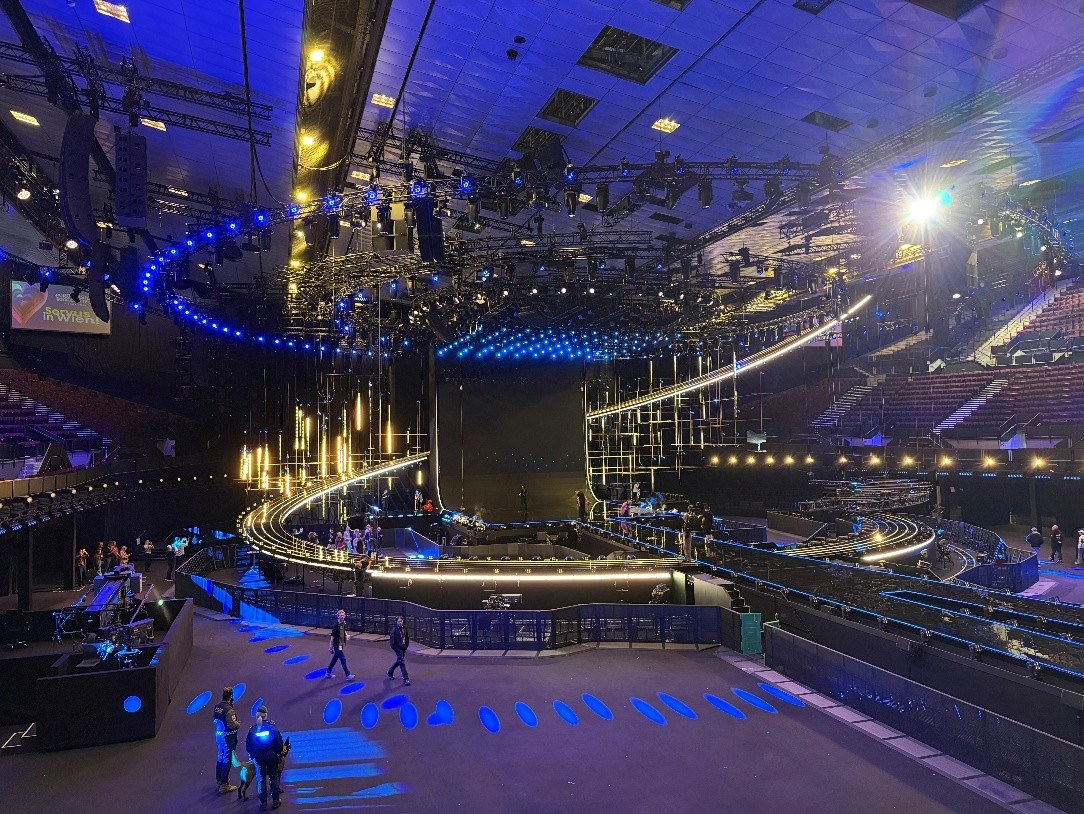
(c) Sebastian Kreuzberger
The Numbers That Put Production in Perspective
At Eurovision 2026, the stage crew had 42 seconds to completely dismantle one act’s set and build the next. Four thousand people worked the show. The stage - designed by Florian Wieder and built specifically for the Wiener Stadthalle - featured more than 2,100 lighting elements alongside 28 live cameras. All of it - every prop, every camera move, every cue - happened live and in real time, with no retakes, in front of an audience of 95,000 ticket holders across nine shows and an expected global viewership of 166 million.
I have dozens of videos from backstage. Camera operators were literally 10 inches from the performers’ faces. Stagehands moved in organized waves. Fire and props arrived on cue. The lighting rig told its own story, independent of what was happening on stage.
The production team shared something I have not stopped thinking about: if one act required more setup time, it was deliberately followed by a simpler act. The complexity was sequenced to protect the timeline. That is not production management. That is strategic design.
What Makes It Possible Has Nothing to Do With Budget
Eurovision’s budget is extraordinary. But the principles behind executing a production flawlessly are not budget-dependent. They are discipline-dependent.
The production team ran nine shows, including the live broadcast, semi-finals, and dress rehearsals with audiences. The dress rehearsal the night before was treated as a real broadcast: if something went wrong during the live show, they could stream the dress rehearsal instead.
Rehearse, rehearse, rehearse. That is not a €32 million lesson. That is a €3,200 lesson.
The team also made something clear about expertise: one of the most critical people in the entire production was the person coordinating the lighting. Not the most visible role. Not the highest title. But the person whose work either made everything feel alive or fell flat. They knew who that person was, and they invested in it.
The Lessons That Travel to Any Budget
- Light creates drama more efficiently than almost any other production element. With more than 2,100 lighting elements at Eurovision creating their own visual story independent of the stage, the principle is clear: before you spend on elaborate staging, ask what a skilled lighting designer could do with what your venue already has.
- Walk your venue’s basement, back-of-house storage, and hallways before you finalize your décor budget. Venues hold years of accumulated props, furniture, and materials that no one thinks to repurpose.
- Sequence your program intentionally. If one session needs complex AV or room transitions, think carefully about what comes before and after it. Design the transitions, not just the content.
- Identify the two or three roles in your event that, if executed brilliantly, would elevate everything else. Put your best people or your highest investment there - not spread evenly across everything.
- Rehearse the moments that matter most: your opening, any technical handoffs, your highest-risk transitions. Once in a room is not a rehearsal. Twice is a start.
Intentional Production Does Not Require a Big Stage
The honest takeaway from watching Eurovision’s production was not “we need more budget.” It was “we need more intention.” The team knew exactly what every second of the show was supposed to feel like. Every decision - from the 42-second stage change to the sequencing of simple and complex acts - was made in service of that feeling.
That level of intention is available to every event professional, regardless of scale. The question is whether we apply it.
Talk to Talley About Leveling Up Your Event Production Strategy